Guide
The annual care plan review, so the renewal is a decision
A care plan renews by silence. The card is charged, nobody opens the agreement, and in month fourteen they ask what the retainer is for. The annual review is the meeting that interrupts that silence. It is not a performance review of you, and it is not a certificate expiry. It is a decision: keep the sheet, rewrite one line, or end it.
The sheet you are reviewing is the care plan agreement. If that page was never sent, the review is the moment you write it, using the year as evidence instead of a guess. The monthly letters are the evidence. How those letters should read, including the months when nothing broke, is on making the work visible and in the quiet-month emails. This page is the conversation that uses them.
What I pull the week before
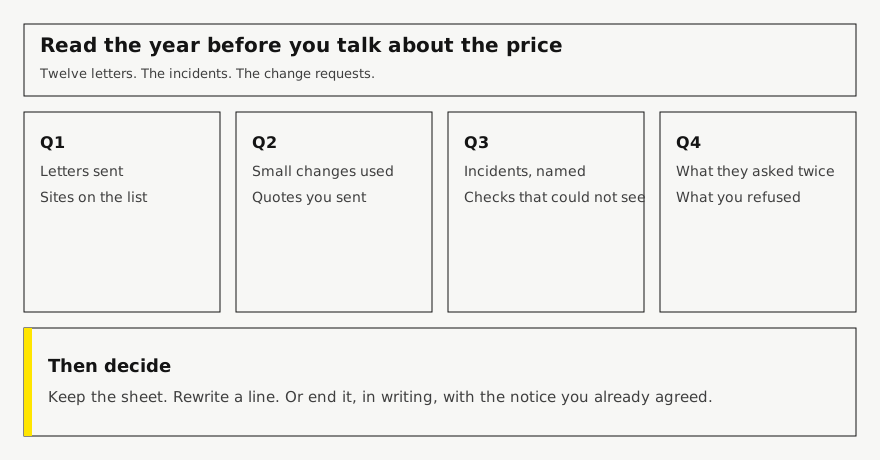
I do not walk into the meeting with a feeling. I walk in with a page I could hand them if the call drops. The gathering takes an hour if the letters exist, and a day if they do not. That day is the argument for sending the letter every month, which you already know, and which you will feel in your stomach if you skipped March.
I open the twelve client pages, or as many as there were. I count small changes that were inside the plan, and change requests that were quoted. I list incidents by the name the client would use, not by an HTTP status. I note any month the check could not see the site, because “unverifiable” is a fact I would rather say myself than have them discover. I list sites that were added without a new line on the agreement, because that is scope creep I did to myself. I list requests I refused, because a refusal is part of the plan working.
I also read the price. If my costs moved, or the work was a different plan than the name on the sheet, I decide the number before the call. I do not invent it while they are talking. A number decided live is a number I discount. The review email, below, goes out with the sheet attached or linked, a few days ahead, so they have read the year before we discuss the fee.
The review I send ahead of the call
Copy this. Brackets are blanks. Harbor & Co, in the next section, is a filled shape. It is not a customer, and the counts are not a measurement from a real year.
Annual care plan review
Client: [name]
Period reviewed: [start] to [end]
Plan on the agreement: [Watch / Care / Studio, price]
Sites still in scope:
- [URL] — [stack] — [keep / remove / add]

What the year contained
- Letters sent: [N of 12]
- Small changes inside the plan: [N]. The cap was [N].
- Change requests quoted: [N]. Accepted: [N].
- Incidents they would recognize:
  - [date]: [one sentence, what they felt]
- Months the check could not tell: [list, or none]
- Requests refused, and why: [one line each, or none]

What I would change on the sheet
- [nothing / a plan rename / a site added or removed / a new small-change count]
- Price for the next period: [same / new amount], starting [date]
- This is not a bill for the year already paid.

Decision, pick one
- Keep. Same lists. Price as written above.
- Rewrite. I will send a replacement agreement. The old one holds until you sign.
- End. Notice of [N] days, last letter on [date], seats removed on [date]. Past letters stay.

Please reply before [date]. If I do not hear from you, the current agreement continues at the current price. I will not raise the price by silence.
The last line is the one I care about. A price increase that arrives as a different number on an invoice is how you lose a client who would have said yes on a call. Silence continues the old price. A new price needs a reply. I would rather bill the old number for another month than win an argument about an email they did not open.
A year, filled in, so you can see the decisions
Harbor is still invented. The point is which facts change the plan, and which facts do not.
Annual care plan review
Client: Harbor & Co, Nora Hale
Period reviewed: 1 April 2026 to 31 March 2027
Plan on the agreement: Care, 240 dollars per month
Sites still in scope:
- https://harbor.example — WordPress — keep
- https://harbor.example/wholesale — same site, money path — keep

What the year contained
- Letters sent: 12 of 12
- Small changes inside the plan: 31. The cap was 4 a month, 48 across the year.
- Change requests quoted: 3. Accepted: 2. One new wholesale tier was declined.
- Incidents they would recognize:
  - 3 June 2026: wholesale page failed its form for about 40 minutes. Fixed the same morning.
  - 12 November 2026: homepage slow after a plugin update. Rolled back the same day.
- Months the check could not tell: none
- Requests refused: a new careers page in August. That was a new page, not a small change.

What I would change on the sheet
- Stay on Care. The cap was not exhausted. Do not move them to Studio to feel busy.
- Price for the next period: 260 dollars, starting 1 May 2027.
- The 20 dollars is said here, not on the May invoice alone.

Decision
- I recommend Keep, with the new price.
- Reply before 20 April 2027.
- Silence keeps 240 dollars. I will not switch the number because a month passed.
Notice what did not change the plan. A quiet-looking count of 31 small changes against a cap of 48 means the cap was about right. I do not shrink Care because they did not use every slice. The slices were reserved. Two real incidents, both named in the letters at the time, are not a reason to apologize for the year, and they are not a reason to add an uptime credit the agreement refused. The refused careers page is the line I most want Nora to see, because it proves the sheet was used.
The price move is small on purpose in the example. Yours might be zero. If it is zero, write zero, so they are not waiting for the catch. If your hosting tool or your own time changed, say the new number in this note and the date it starts. Do not itemize a fake breakdown you cannot defend. “The plan is 260 from 1 May” is a sentence. A spreadsheet of imagined hours is a negotiation you did not mean to open.
The email that books the meeting
I send the sheet, then I offer a call. The call is optional if they reply in writing. Some clients want twenty minutes. Some want to reply “keep.” Both are a review.
Subject: Harbor care plan, the year, and the price from 1 May

Nora,

The care plan review is attached. Twelve letters went out. Two incidents are named in it. One request, the careers page, stayed a quote.

I recommend we keep Care. The price from 1 May would be 260 dollars a month. Until you reply, it stays 240.

If you want twenty minutes, I have [Tuesday 15:00] or [Wednesday 10:00]. A reply of “keep” is also enough.

Northline
Do not open with the new price in the subject if the subject can be the year. The price is in the second paragraph, where it cannot hide, and it is not the only sentence. A subject line that is only “price increase” gets the defensive read before they have seen the twelve letters. A subject line that hides the price is the other failure. The body says the number.
If the year was bad, say that in the first paragraph. “The wholesale form failed twice and the second time I was slow” belongs above the fee. I have buried a bad month under a cheerful renewal and then been surprised when they had kept the email. They always kept the email. Write the incident in their words, the same way the letter did, and do not re-litigate it.
Keep, rewrite, or end
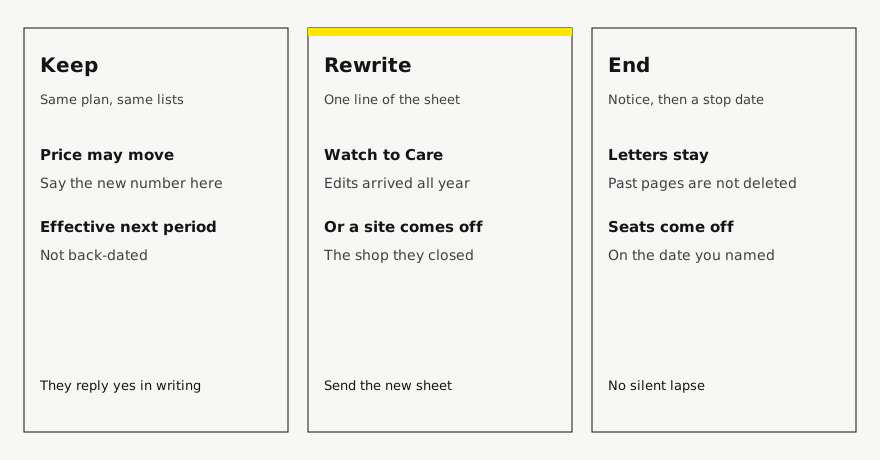
Keep means the lists are still true. The small-change count was in the right neighborhood. The sites are the same sites. A price can still move, said in the review, effective on a date after they reply. Keep is the common outcome, and it should feel slightly boring. Boring means the agreement was specific enough to survive a year.
Rewrite means one line is lying. The usual lie is the plan name. Watch clients who sent edits every month are Care clients. Care clients who needed a new page every month are looking at Studio, or at a project retainer with its own scope. The other usual lie is the site list: a campaign URL that became permanent, or a shop they closed in October that you are still checking out of habit. Rewrite by sending a replacement of the agreement. The old sheet holds until they accept the new one. I do not switch the work and hope the signature catches up.
End is a complete sentence. Use the notice you already wrote, name the last letter, name the date the seats come off, and say the past letters stay. Ending is not a failure of the review. A review that cannot end is a hostage situation with a monthly invoice. I have ended plans where the work had become a different job, and the kind thing was to say so before another quiet year. I have also been ended by the client. The same template works. Their email can be the decision line. You still send the stop date and the seat date back, so nobody is guessing.
A quiet year is not a discount
The pressure in a quiet year is to apologize with a lower price. I do not. The plan reserved the attention. The letters documented the quiet on purpose, which is why the quiet-month note exists. If you discount because nothing broke, you have taught them that the fee is a penalty for incidents. Next year they will want the incidents, or they will want the discount again. Neither is the product.
The opposite pressure is to inflate the year with plugin version rows so the fee looks busy. Do not. They have had twelve chances to read version rows, and they did not. The review repeats outcomes, not the dashboard. If the only true sentence is “the site stayed up and I changed the phone number twice,” write that. A thin true year beats a thick invented one. I am not going to supply you with a statistic about retention. I do not have one. I have the habit of putting the year on one page so the renewal is a reply instead of a shrug.
What the review must not smuggle in
It must not add an uptime guarantee the agreement refused. A year of 99-point-something in the letters is what the probes saw. It is not a credit schedule. It must not become a security attestation because their insurer sent a questionnaire. Answer the questionnaire as itself, or decline it. Do not staple it to the renewal and hope the word maintenance covers a control you never ran.
It must not add sites that were never on the list without saying so. If you checked a fourth URL all year, the review is where you either add it, with the price consequence, or stop checking it. Silent scope is how the next agreement is already false on day one.
It must not renegotiate the tool stack as a surprise. If you are moving their WordPress updates from one dashboard to another, say that only if they will feel it. Most of them will not. They will feel the letter and the seat. The letter’s shape, if you want a reminder before the meeting, is the report template. The review does not replace those twelve pages. It points at them.
After they reply
Keep: file the reply next to the agreement, change the price on the date you named, and send the next letter on the usual day. Do not send a celebratory extra email. The next letter is the proof the plan continued.
Rewrite: send the replacement agreement within a few days, with the changed lines marked in prose at the top. “Small changes move from four to six. Price moves from 240 to 300 on 1 May. Everything else is the same sheet.” Ask for the same signature you asked for the first time. Start the new scope on the date, not on the afternoon they seemed warm to it.
End: put the stop date on your calendar, send the last letter, remove your seat on the date, and leave their registrar and their password alone if they were never yours. Rotate the client link if the agreement said links stay but a shared inbox should not keep a live token. Say which one you did. Then stop writing monthly. A farewell sequence is a new retainer they did not buy.
Put the next review date on the sheet you just renewed, one year out, the same way the original agreement carried the first date. The point of this page is that the date is a meeting you already know how to run. You do not need a new format in year three. You need the same blanks, and the honesty to pick keep, rewrite, or end while they are still reading.
Plans are Starter at $9/month for up to 5 sites, Studio at $29/month for up to 25 sites, and Agency at $79/month for up to 100 sites. Starter, including a trial, keeps a small Powered by RetainerProof link on the client digest and the public status page. Studio and Agency remove that link. Prices are on the pricing page.
Related guides
- Reporting for agencies
- Beyond WordPress
- Maintenance report template
- ManageWP alternative
- Uptime report
- Prove retainer value
- Care-plan reporting
- Client status pages
- MainWP alternative
- Quiet-month emails
- Reporting tools
- ManageWP alternatives
- Contract template
- Status page comparison
- Client work log
Also see pricing and a sample client digest.
Monthly agency tip
One tip a month.
One practical tip a month on proving your retainer is worth it. No spam.
I email a confirmation link before I add you. I store the address, this page, and the date. Unsubscribe any time. Read the privacy page.